CRAFT: Constrained Reward via Attention Fine-Tuning for Subject Personalization without Composed Targets

Jihun Park1,*, Kyoungmin Lee1, Jongmin Gim1, Hyeonseo Jo1, Jaeyeul Kim1, Han Zou2, Zhenpeng Zhan2, Yan Zhang2,†, Sunghoon Im3,†
1DGIST  ·  2Baidu, Inc.  ·  3KAIST
🎉 ACM SIGGRAPH Asia 2026 🎉
*Work done during an internship at Baidu, Inc.

Corresponding Author
CRAFT teaser

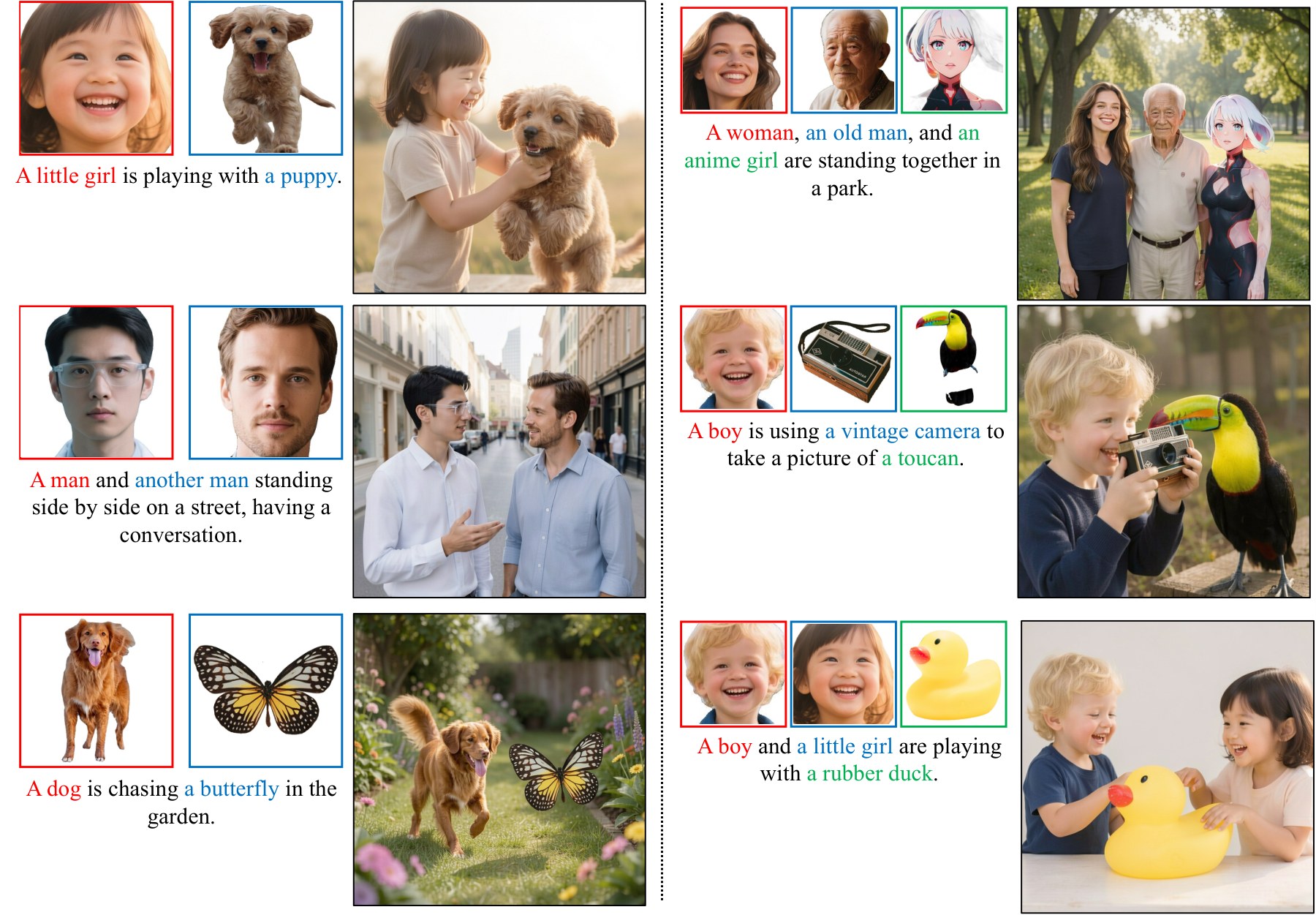
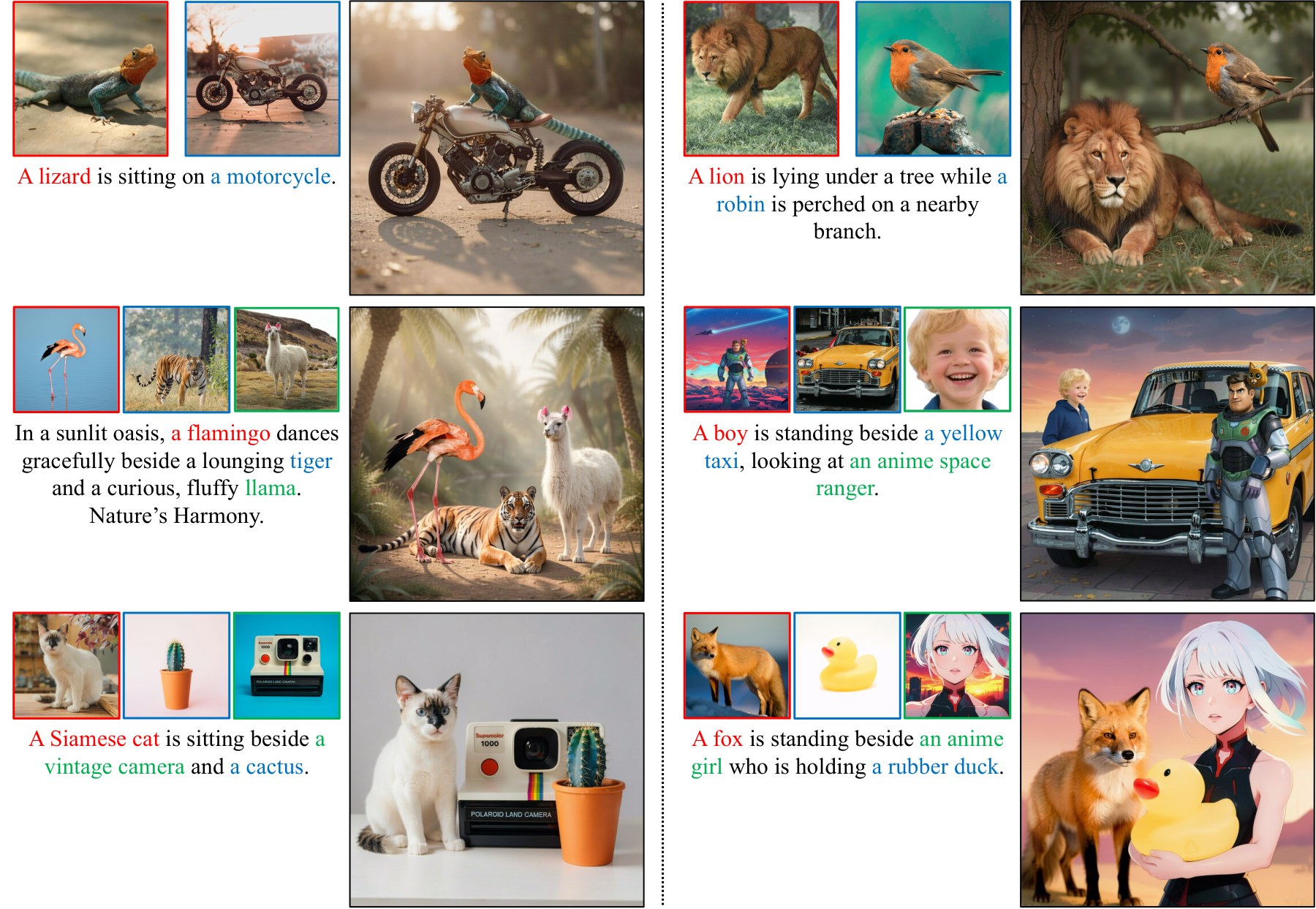
Subject-driven personalization with CRAFT. Given one or several reference subjects and a text prompt, CRAFT generates new scenes that preserve each subject's identity while following the prompted interaction — trained with only 10K reference images and subject masks, and no composed-target supervision.

Abstract

Subject-driven image personalization—generating new images that preserve the identity of one or several reference subjects in novel scenes—is a foundational capability for modern visual content creation. It is currently dominated by generalized methods that fine-tune a pretrained multimodal diffusion transformer (MMDiT) on hundreds of thousands to millions of paired (reference, composed-target) examples, where each composed target is a synthesized image of the subject in a novel scene. Producing such targets demands a costly multi-stage curation pipeline—LLM-based prompt generation, T2I-based composed-target synthesis, reference-subject extraction, VLM-based quality filtering, and correspondence labeling—and tightly couples each method to a particular target synthesizer and curation choice. We introduce CRAFT (Constrained Reward via Attention Fine-Tuning), a single-step ReFL framework that fine-tunes a pre-trained reference-aware MMDiT via LoRA adapters using a compact reference-only data construction—10K reference images and subject masks, with no composed-target supervision. CRAFT realizes a Where to look principle: attention-level rewards align noise- and phrase-token attention with the correct reference subject, and the resulting per-subject attention masks gate a pixel-level identity reward to keep image-space supervision consistent with the learned attention routing. Applied to FLUX.2-klein-9B, CRAFT achieves state-of-the-art performance on XVerseBench while using no composed-target supervision—only 10K reference-only samples, whereas prior generalized methods require 150K to over 2M composed-target pairs. The same recipe transfers to other reference-aware backbones, consistently improving performance.
✨ Method Overview

Key observation. Reference-aware MMDiTs, which jointly attend to text, noise, and reference-image tokens, already produce subject-aligned attention patterns before any fine-tuning. Rather than inducing this routing through large-scale composed-target supervision, CRAFT shapes the existing routing directly with a lightweight reward signal.

Where to look principle. At a small subset of (step, block) coordinates, noise- and prompt-token attention should land on the correct reference subject region. The supervision this requires is minimal — just reference images paired with subject masks.

Overall pipeline of CRAFT
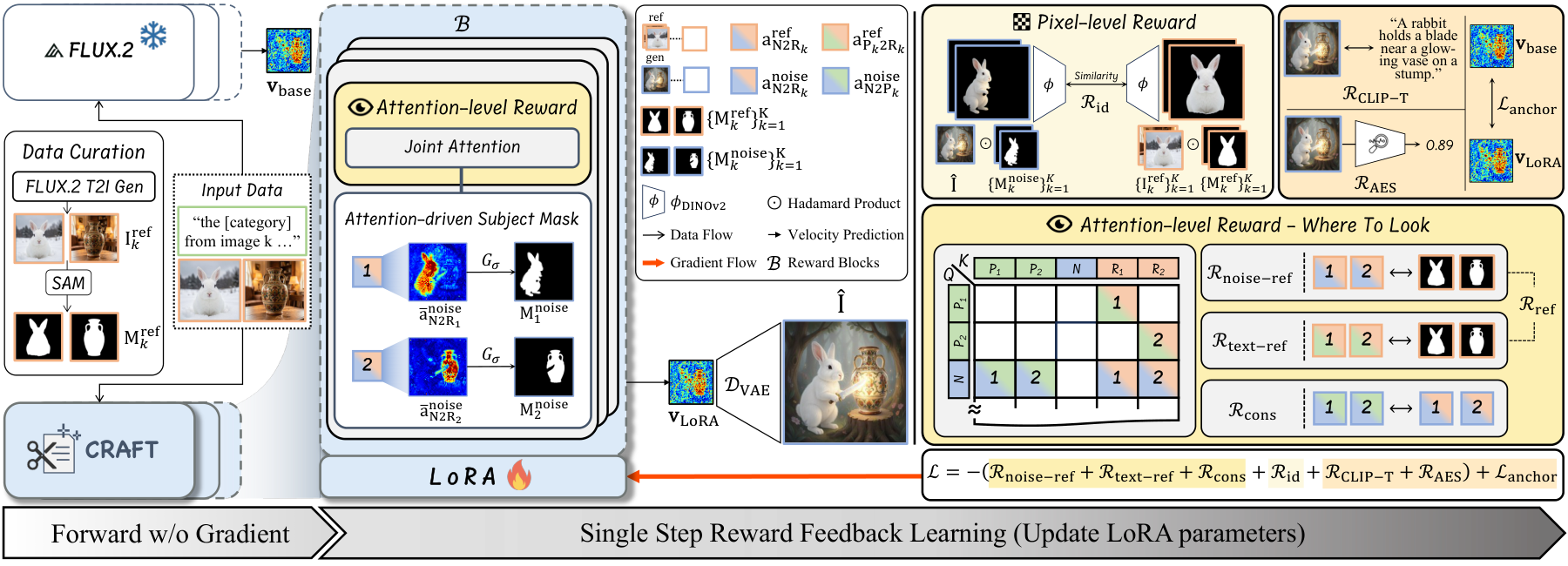
Overall pipeline of CRAFT. The denoising prefix is rolled out without gradients up to the reward step \(t^\ast\), where two forward passes are performed: the frozen backbone \(f_\text{base}\) produces \(\mathbf{v}_\text{base}\), while the LoRA-adapted model \(f_\text{LoRA}\) produces \(\mathbf{v}_\text{LoRA}\) together with the cross-modal attention sub-blocks \(\mathbf{A}_{N2R_k}\), \(\mathbf{A}_{N2P_k}\), and \(\mathbf{A}_{P_k 2 R_k}\). Following the Where to look principle, \(\mathcal{R}_\text{ref}\) and \(\mathcal{R}_\text{cons}\) shape noise- and phrase-token attention toward each reference subject; the resulting per-subject mask \(\mathbf{m}^\text{noise}_k\) then gates the pixel-level identity reward \(\mathcal{R}_\text{id}\) on the VAE-decoded pre-image \(\hat{\mathbf{I}}\). Auxiliary terms \(\mathcal{R}_\text{CLIP-T}\), \(\mathcal{R}_\text{AES}\), and a velocity-space regularizer \(\mathcal{L}_\text{anchor}\) are added for prompt fidelity, aesthetics, and stability. A single backward pass updates only the LoRA parameters.

1. Reference-mask alignment \(\mathcal{R}_\text{ref}\)

Pulls both noise queries (\(\mathbf{A}_{N2R_k}\)) and subject-referring phrase queries (\(\mathbf{A}_{P_k 2 R_k}\)) toward the reference-token region \(\mathbf{m}^\text{ref}_k\), so the model extracts subject evidence from the correct part of the reference image.

2. Text–noise consistency \(\mathcal{R}_\text{cons}\)

Projects \(\mathbf{A}_{N2R_k}\) and \(\mathbf{A}_{N2P_k}\) onto the noise grid and maximizes their probabilistic soft IoU, so the two views of subject \(k\) localize at the same place — suppressing duplicated or misplaced subjects in multi-subject scenes.

3. Attention-gated identity \(\mathcal{R}_\text{id}\)

\(\mathbf{A}_{N2R_k}\) itself yields a per-subject noise-grid mask \(\mathbf{m}^\text{noise}_k\) (Gaussian smoothing + thresholding), which gates a DINOv2 identity reward on the decoded pre-image — no external segmentation of the generated image required.

Implementation. CRAFT is built on FLUX.2-klein-9B, an MMDiT distilled to four denoising steps, with the backbone frozen and LoRA adapters (rank \(r=64\)) attached to all attention layers. Training runs at \(1024^2\) resolution for 3,000 optimizer steps on four NVIDIA B200 GPUs with AdamW (lr \(2\times10^{-6}\)). A subject-routing analysis on the unmodified backbone fixes the reward locus at \(t^\ast = 2\) and \(\mathcal{B}\) = {single_1, single_9, single_8}. Subject masks are used only on the reward side during training — the model never receives them, so inference remains mask-free.

Why reference keys?

Reference-key vs. text-key attention
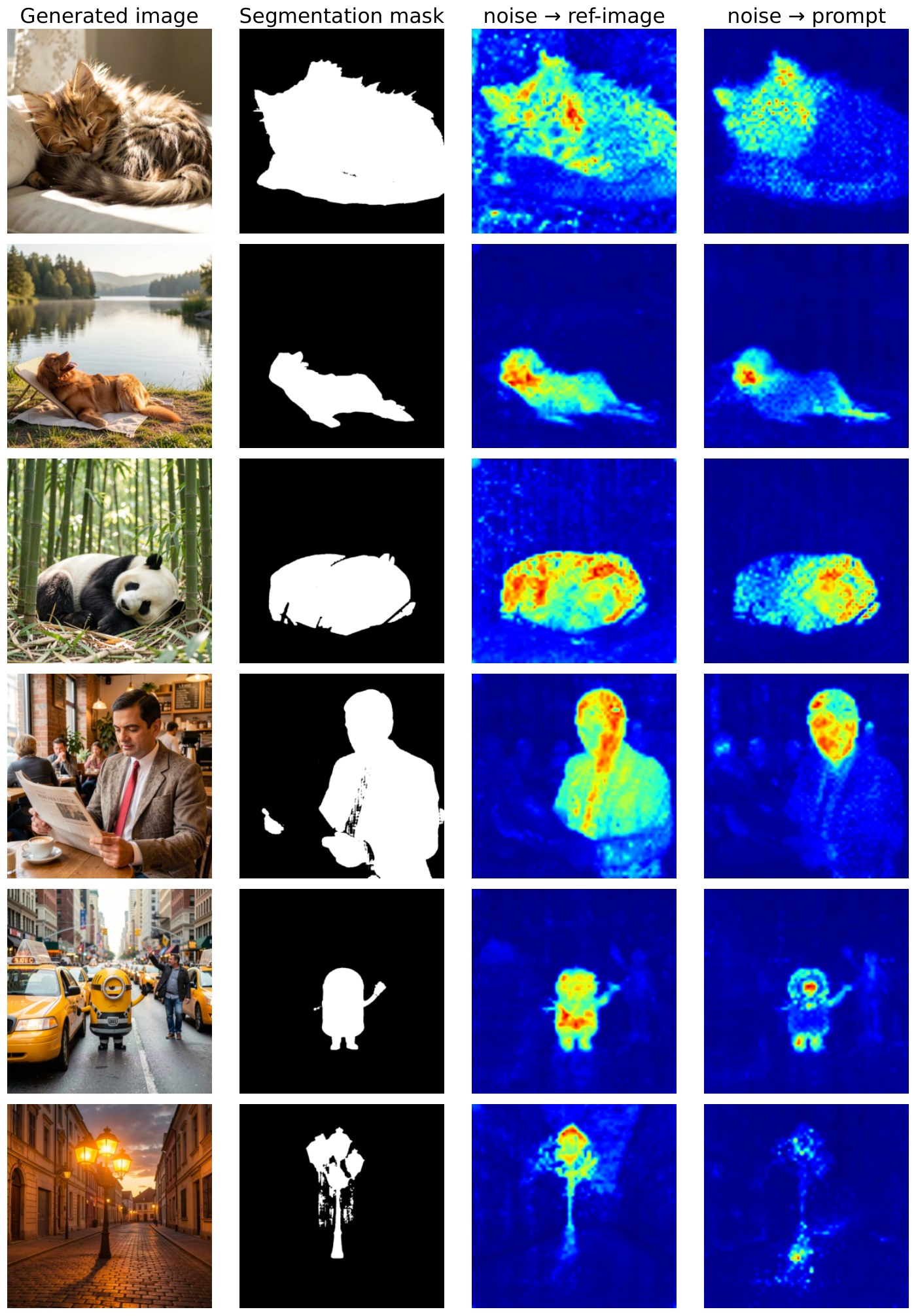
Qualitative comparison of raw (un-thresholded) \(\mathbf{A}_{N2R}\) (noise-to-reference) and \(\mathbf{A}_{N2P}\) (noise-to-prompt) attention heatmaps at \(t^\ast{=}2\), block single_1, shown alongside the Grounded-SAM segmentation of the generated image. \(\mathbf{A}_{N2R}\) concentrates on the actual subject region and aligns with the segmentation mask; \(\mathbf{A}_{N2P}\) is more diffuse and frequently leaks outside the subject — which is why the attention-derived gate is built from the reference-key attention.

📊 Results

Quantitative Comparison on XVerseBench

“Target.” marks composed-target supervision; “#Data” is the reported training-sample count. denotes results reproduced with official code; () denotes not reported. Best/second-best in bold/underlined. * CRAFT (mask-free) operates on raw, unsegmented references at inference and is reported for reference (not included in the ranking) — this is CRAFT's intended inference mode, and it performs on par with or above the segmented-input configuration.

Method Target. #Data Single subject (90 prompts) Multi subject (210 prompts) Overall ↑
DPG ↑ ID ↑ IP ↑ AES ↑ AVG ↑ DPG ↑ ID ↑ IP ↑ AES ↑ AVG ↑
UNO 245K 89.65 47.91 80.40 55.90 68.47 85.28 31.82 67.00 54.24 59.59 64.03
OmniGen 6.5M 83.90 76.51 78.46 51.41 72.57 78.23 55.53 62.32 49.84 61.48 67.03
OmniGen2 180K 92.60 62.41 74.08 52.34 70.36 91.55 40.81 67.15 51.40 62.73 66.55
DreamO 150K 96.93 75.48 70.84 54.57 74.46 88.80 50.24 64.63 52.47 64.04 69.25
UMO 86.75 77.36 76.99 61.71 75.70 87.18 58.24 60.52 58.74 66.17 70.94
XVerse 2M+ 93.69 79.48 76.86 56.84 76.72 88.26 66.59 71.48 53.97 70.08 73.40
MOSAIC 1.2M 96.55 81.98 80.92 60.77 80.05 88.94 69.90 74.27 55.02 72.03 76.04
CRAFT (Ours) 10K 96.81 84.22 84.23 61.24 81.62 88.71 61.16 77.25 58.16 71.32 76.47
CRAFT (mask-free, Ours)* 10K 98.91 87.67 86.74 62.58 83.97 89.12 60.35 77.28 59.71 71.62 77.80

CRAFT achieves the best Overall score (76.47) while using only 10K reference-only training instances and no composed-target supervision. On the single-subject split it obtains the best AVG (81.62), improving over the strongest prior method (MOSAIC) by +1.57 points, with the largest gains on identity-related metrics (Single ID 84.22, Single IP 84.23). Compared with the frozen FLUX.2-klein backbone, CRAFT improves Overall by +5.43 points.

Qualitative Comparison

Qualitative comparison with state-of-the-art personalization models
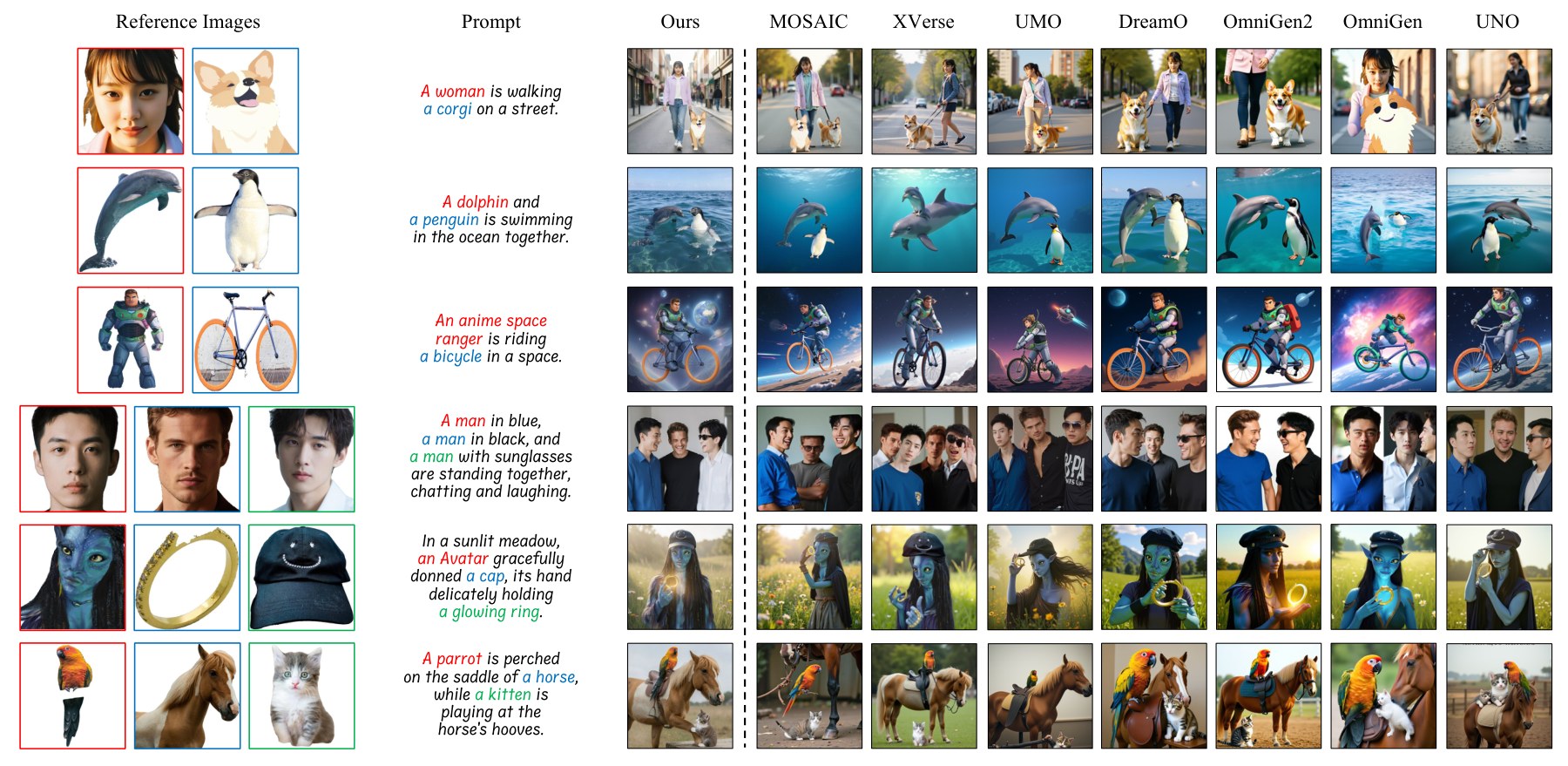
Qualitative comparison with state-of-the-art subject-driven personalization models. CRAFT places subjects at compatible positions, orientations, and scales so that the prompted interaction is visually supported — a woman walking a corgi, a character physically situated on a bicycle, a cap and ring integrated with the Avatar. Competing methods often preserve reference appearance but drop a subject, place subjects in disconnected regions, or distort one subject to accommodate the other.

Component Ablation

(a) FLUX.2-klein backbone; (b) \(+\mathcal{R}_\text{ref}\), (c) \(+\mathcal{R}_\text{cons}\) (cumulative); (d) \(\mathcal{R}_\text{id}\) alone on the backbone; (e) full CRAFT. Best/second-best in bold/underlined.

Component Single subject Multi subject Overall ↑
\(\mathcal{R}_\text{ref}\) \(\mathcal{R}_\text{cons}\) \(\mathcal{R}_\text{id}\) DPG ↑ ID ↑ IP ↑ AES ↑ AVG ↑ DPG ↑ ID ↑ IP ↑ AES ↑ AVG ↑
(a) 97.22 66.29 78.15 59.76 75.36 88.91 50.22 71.23 56.52 66.72 71.04
(b) 96.89 70.15 79.75 60.84 76.91 88.94 48.11 72.69 57.86 66.90 71.91
(c) 97.22 70.63 81.19 61.94 77.75 88.09 50.43 70.70 58.71 66.98 72.37
(d) 96.67 73.27 81.93 61.96 78.46 87.32 50.77 72.90 60.24 67.81 73.14
(e) 96.81 84.22 84.23 61.24 81.62 88.71 61.16 77.25 58.16 71.32 76.47

The attention rewards and the pixel identity reward are complementary. \(\mathcal{R}_\text{id}\) alone (d) already improves over the backbone, but adding \(\mathcal{R}_\text{ref}\) and \(\mathcal{R}_\text{cons}\) sharpens the attention-derived gate and yields a further jump to 76.47 Overall — image-space identity supervision is most effective when the gate that localizes it is itself shaped by the attention rewards.

Transfer to Other Backbones

CRAFT applied to UNO and UMO on XVerseBench. denotes results reproduced with official code.

Method Target. Single AVG ↑ Multi AVG ↑ Overall ↑
UNO 68.47 59.59 64.03
UNO + Ours 76.61 67.04 71.83
UMO 75.70 66.17 70.94
UMO + Ours 79.75 69.49 74.62

UNO + CRAFT — supervised entirely by reference-side rewards — outperforms UMO, which is itself a reward-based fine-tuning of the same UNO backbone but requires composed-target supervision.

User Study (119 participants)

Preference (%) on Identity Consistency (IC), Prompt Fidelity (PF), and Image Quality (IQ). For each question, participants see image sets from four methods in randomized order and select the best.

Method IC ↑ PF ↑ IQ ↑
UMO 15.0 5.9 26.0
XVerse 15.0 18.3 16.5
MOSAIC 14.8 13.2 23.3
Ours 55.2 62.6 34.2

CRAFT is preferred by a large margin on identity consistency and prompt fidelity against the top three quantitative performers.

🖼️ More Qualitative Results

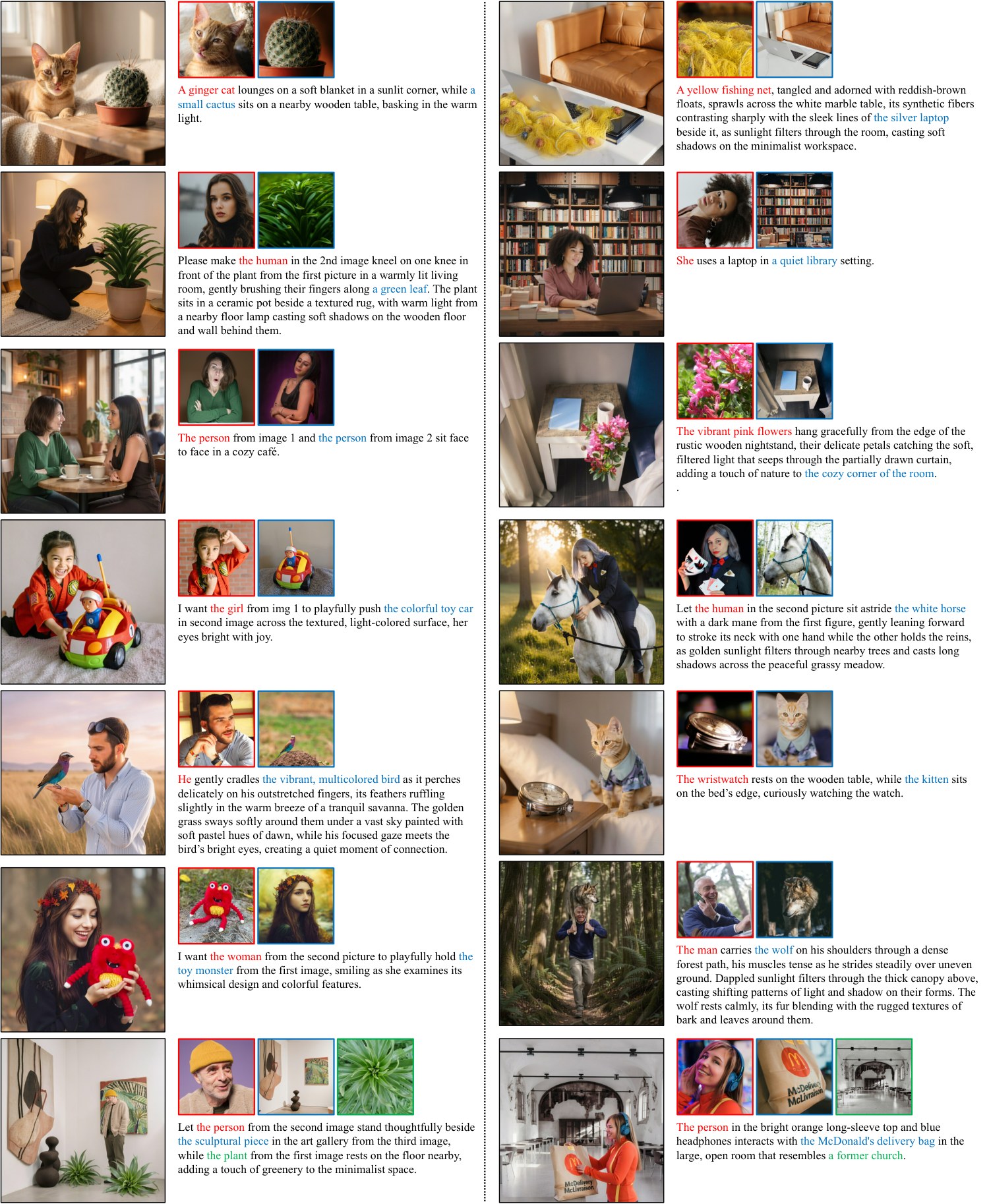
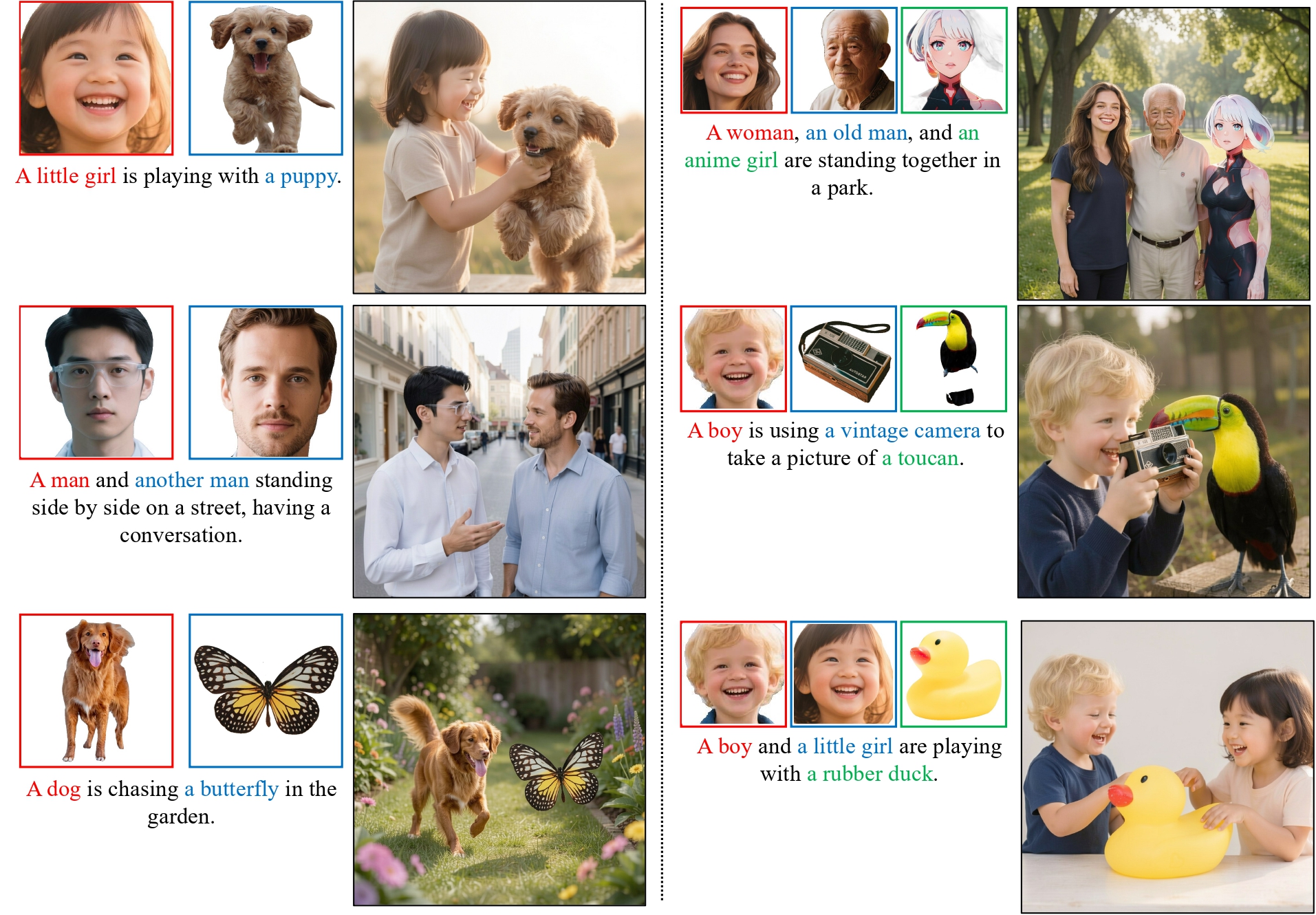
Because subject masks are used only as reward-side training annotations, CRAFT runs on raw, unsegmented references at inference (mask-free protocol) and reaches an even higher Overall score (77.80) than the segmented-input configuration.

Reference-Only Training Data

Dataset curation pipeline
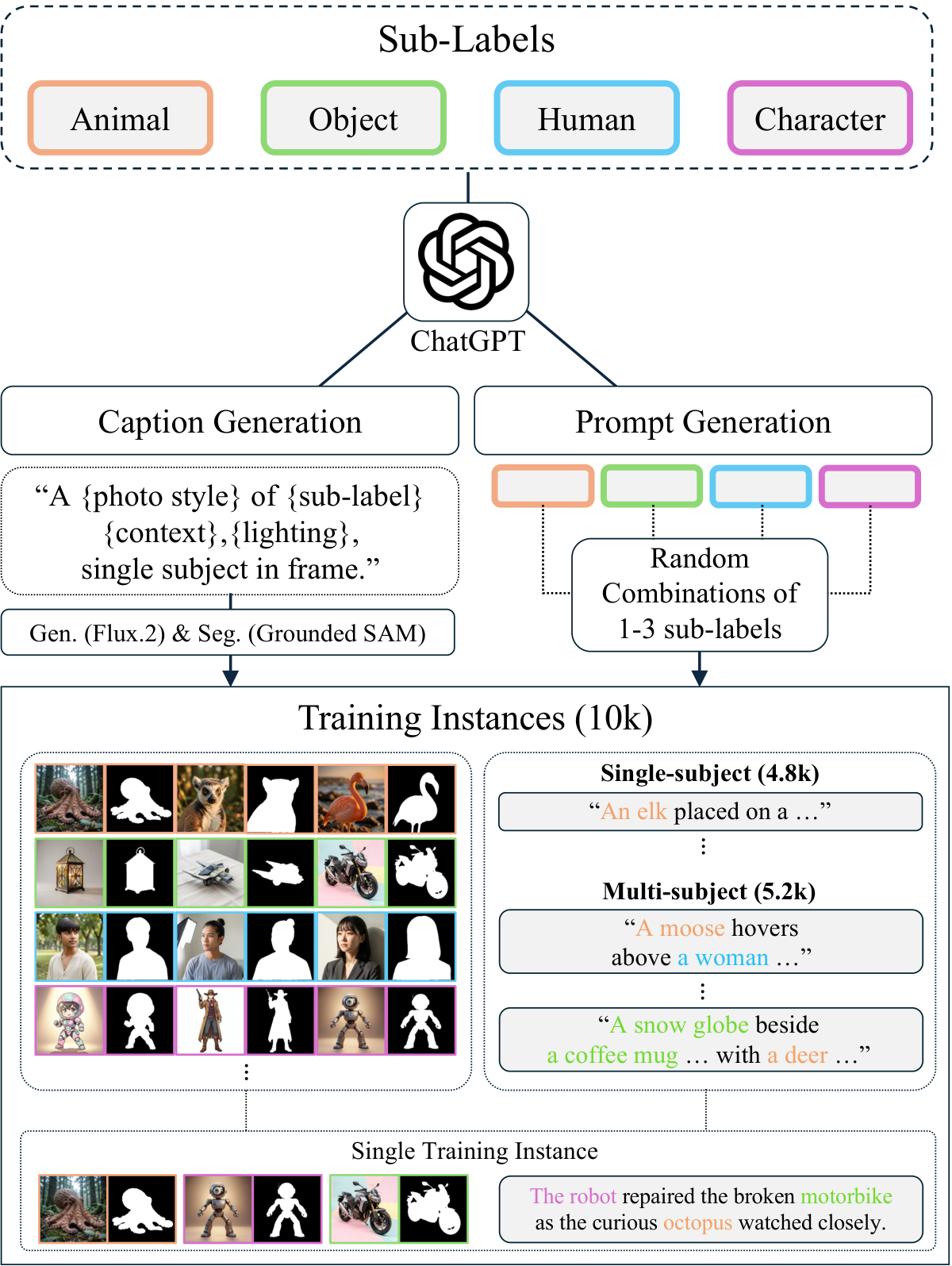
Overall pipeline of dataset curation. References are isolated single-subject images rendered with FLUX.2 in text-to-image mode, and each subject mask is obtained with Grounded-SAM. No scene composition or composed-target synthesis is involved — 10K reference-only instances in total, versus the 150K to over 2M composed-target pairs prior generalized methods require.